Why Modern Brand Growth Demands Integration, Not Handoffs.
The marketing funnel was built for a world that no longer exists.
Awareness → Consideration → Conversion → Done → Move On...
While that framework may have worked in the past, today’s buyers don’t move in straight lines. Modern customers move fluidly across channels, conversations and experiences, which means integrated marketing strategy must guide the entire customer journey (not just the moment of conversion).
This is especially true in automotive marketing, emerging tech marketing and B2B marketing, where consideration cycles are long, touchpoints are layered and trust is built over time.
Today’s customers tend to:
- Bounce between channels, devices and conversations
- Research, pause, compare, revisit and advocate
- Move forward based on personal experiences and trusted signals
If customer behavior is non-linear, it's safe to say that brand strategy should be too.
Why the Traditional Marketing Funnel No Longer Works
Funnels assume marketing happens in stages, but real customer journeys rarely follow a clean path. A prospect might discover your brand through an event, research your product months later, engage with influencer content and only then convert after a recommendation from a peer.
In automotive, a test drive might happen after months of digital research.
In emerging technology, a demo may occur long before a buying decision.
In B2B marketing, the buying committee may revisit content multiple times across multiple channels before moving forward.
These journeys don’t move downward through a funnel; they move in loops.
Why Integrated Marketing Strategy Requires a Feedback Loop
Instead of a one-way funnel, modern brands operate through feedback loops:
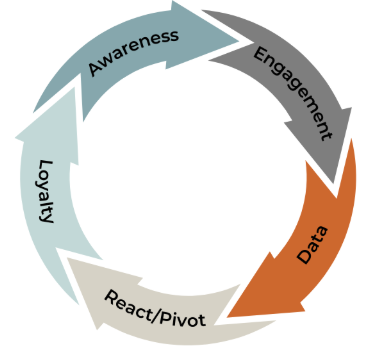
- Awareness fuels engagement
- Engagement fuels data
- Data fuels a pivot toward smarter experiences
- Smarter experiences fuel loyalty and advocacy
- Advocacy fuels new awareness
This is not a campaign cycle; it’s a marketing ecosystem.
Loops prioritize long-term brand equity over short-term clicks. They rely on continuity across channels and require real integration between strategy, creative, technology and data. And this is where many brands struggle. Not because they lack ideas, but because their partners operate in silos.
If strategy lives in one deck, creative lives in an isolated department and web development is outsourced, the result is often fragmented execution and delayed insight. When that happens, data arrives too late to influence meaningful optimization.
How Data, Creative and Technology Close the Loop
When signals don’t connect, the loop never closes. Consider what happens when marketing systems truly integrate:
- In automotive marketing, a test drive should inform future messaging.
- In emerging tech marketing, product demos should refine content strategy.
- In B2B marketing, gated content should shape sales enablement and retargeting.
Each interaction generates insight and that insight should inform the next experience. When that connection is missing, brands fall back into "campaign thinking" instead of "ecosystem thinking."
We Build Loops, Not Campaigns
At the JRT agency®, our integrated model brings marketing strategy, creative production, web-based applications, data management and experiential marketing together under one roof. We don’t start with assets; we start with how the brand should function across its ecosystem.
Strategy orchestrates how the loop works. That means segmenting audiences based on real data and designing marketing programs that evolve over time rather than expire after a campaign ends. With strategy guiding the system, creative sets the loop in motion. Not one-off creative. Creative designed to evolve, adapt and generate ongoing engagement.
Data Management That Feeds Back into Strategy
Every effective loop depends on digital infrastructure. The digital experience is not just a destination; it’s a data engine.
Thinking ahead to meaningful KPIs allows the right systems to be built from the start. Connected web ecosystems, interactive tools, configurators and custom applications can then generate the signals that drive smarter strategy. On top of that, reliable technology makes it possible to monitor performance, adjust messaging and pivot in real time. Instead of reporting what happened, marketing becomes capable of shaping what happens next.
Experiential and Influencer Marketing as Loop Accelerators
From live activations that feed digital retargeting to influencer content integrated into broader campaigns, experiential marketing plays a powerful role in the loop model. Experiences generate emotion which generates content. Content generates engagement, credibility and momentum, which influencers can then amplify.
Each interaction creates another signal that feeds the ecosystem.
What Loop Thinking Means for Brand Leaders
For modern brands, the loop only works when everything connects; teams must collaborate, data must flow, creative must align with strategy and technology must support the entire process.
Integration isn’t a service add-on at the JRT agency, it's our operating model. We integrate brand strategy and business processes so marketing doesn’t operate alongside the business. It operates as part of it.
This approach is especially critical in automotive, emerging technology and B2B marketing, where complexity demands coordination across channels, stakeholders and systems.
If you’re leading a brand today, ask yourself these questions:
- Are your campaigns learning from each other?
- Does your data inform your creative?
- Do your experiences connect to your digital ecosystem?
- Are your partners collaborating or simply handing off work?
If the answer to the above is no, you’re still building funnels. And in today’s market, funnels leak.
When Brands Start Thinking in Loops
But when brands start thinking in loops, something powerful happens. Campaigns start learning from each other, experiences fuel content, content fuels engagement and engagement fuels insight. Modern brand ecosystems grow by applying that insight toward smarter strategy.
At the JRT agency, this loop mindset shapes everything we build, from integrated campaigns to experiential platforms and digital tools designed to continuously feed insight back into strategy. An example is the bproauto® Next-Level Tourney, where we combined gamification, dealer engagement and digital interaction around a March Madness-style tournament to create an experience designed to generate participation, competition and ongoing momentum across a national dealer network.
Instead of a one-time campaign, the program evolved into a living brand ecosystem, one that connects engagement, sales performance and brand advocacy.